
Goldman Sachs Strategist: Is the Stock Rally Safe?
A Goldman Sachs strategist sees continued support for US stocks from strong earnings and AI investment, but high valuations and rising volatility are creating fresh risks.
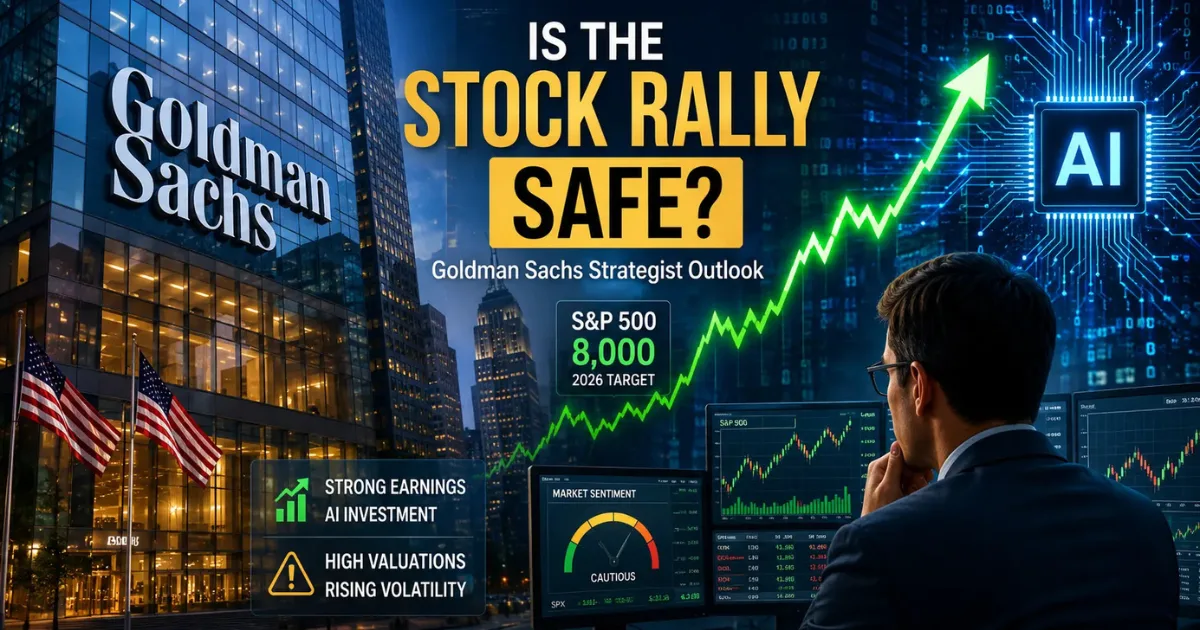
Wall Street is watching a tricky mix of strong earnings, huge artificial intelligence spending, high valuations and shifting interest-rate expectations. A Goldman Sachs strategist is therefore drawing attention because investors want to know whether the powerful 2026 stock rally can continue or whether volatility is about to return.
What is the Goldman Sachs strategist saying about stocks?
Goldman Sachs strategists remain broadly constructive on US equities, but their message is not a simple “buy everything” call. In May, chief US equity strategist Ben Snider and his team raised their year-end 2026 S&P 500 target to 8,000 from 7,600. They also lifted their earnings-per-share forecast to $340 for 2026, with another increase expected in 2027.
Goldman says the US rally has been powered mainly by corporate profit growth rather than by investors simply paying higher prices for stocks.
Why is AI so important to the Goldman Sachs strategist outlook?
Artificial intelligence has become one of the biggest forces shaping the market. Goldman estimates that major hyperscale technology companies could spend about $754 billion on capital projects in 2026, with spending potentially reaching $905 billion in 2027.
Goldman expects AI infrastructure beneficiaries to generate roughly half of S&P 500 earnings growth in 2026 and 2027.
But there is a catch. Companies eventually need to turn enormous AI investments into real productivity gains and recurring profits. If that payoff takes longer than investors expect, high-growth technology shares could face sharper pressure.
Are US stocks too expensive right now?
Valuation is one of the biggest reasons for caution. Goldman’s May research said the S&P 500 was trading near 21 times forward earnings, around the 88th percentile of its 40-year history.
That does not automatically mean a crash is coming. It means investors have less room for disappointment. If earnings beat expectations, expensive stocks can keep rising. If growth slows or AI profits disappoint, the same high valuations can magnify losses.
This is why investors should watch earnings forecasts, Treasury yields, inflation and market breadth together instead of relying on one headline number.
Why is volatility becoming a bigger concern?
Another Goldman Sachs strategist, Tony Pasquariello, has warned that newer market structures could keep volatility elevated. His concerns include the growing weight of AI-linked shares in the S&P 500 and increased speculative activity involving short-dated options and leveraged exchange-traded funds.
The message is important for everyday investors: a bullish market can still produce sudden, uncomfortable swings. Strong index performance does not mean every stock will move higher at the same speed.
Recent market coverage also shows that investors have returned strongly to US equities in August, while other strategists warn that optimism leaves little room for mistakes. (source: Financial Times)
What could push the market higher?
There are several potential positives.
Strong corporate earnings could support higher share prices.
Falling inflation could reduce pressure on interest rates.
AI investment could keep boosting technology and industrial profits.
Better economic growth could broaden the rally beyond a small group of companies.
A calmer geopolitical environment could improve investor confidence.
Goldman’s 2026 outlook expects global growth of 2.8%, above the 2.5% consensus forecast, while its equity strategy remains constructive on stocks. (source: Goldman Sachs Research)
What could trigger a market pullback?
The biggest risks are not difficult to identify. Inflation could remain stubborn, Treasury yields could rise, consumer spending could weaken, or geopolitical tensions could increase energy prices.
Goldman has also highlighted narrow market breadth and strong momentum as warning signs. In other words, the rally may be relying heavily on a smaller group of winners. If those leaders stumble, the broader index could feel the impact quickly.
Investors should also remember that forecasts are scenarios, not guarantees. A target such as 8,000 describes what strategists believe is possible under their assumptions; it does not promise that the market will reach that level.
What does this mean for everyday investors?
For ordinary investors, the Goldman Sachs strategist debate is less about predicting the exact next market move and more about managing risk.
A practical checklist is:
Avoid putting a portfolio entirely into one technology theme.
Check whether company earnings support high valuations.
Keep an eye on inflation and bond yields.
Consider diversification across sectors and regions.
Match investment risk with your own time horizon.
The goal is to understand what assumptions sit behind the forecast and what could make those assumptions wrong.
For more market context, see [insert related article link here] on the latest Europe and global business news.
What should investors watch next?
The next major clues will come from corporate earnings, inflation data, Federal Reserve communication and the sustainability of AI spending. Markets will watch whether gains spread beyond technology names.
Goldman’s research suggests the bull market still has support from earnings growth, but it also recognizes that valuations, momentum and narrow leadership can raise risk. That combination makes the second half of 2026 interesting.
The market can remain bullish while becoming more fragile. A Goldman Sachs strategist may provide a framework, but investors still need to weigh evidence, diversify and avoid treating any forecast as certainty.
FAQs:
Is Goldman Sachs bullish on the S&P 500?
Yes. Goldman raised its year-end 2026 S&P 500 target to 8,000 in May.
Why does Goldman like AI stocks?
Goldman sees strong AI investment supporting earnings growth across technology and related infrastructure.
Is the S&P 500 overvalued?
Valuations are historically high, which means investors have less room for disappointing earnings.
Could stock market volatility increase?
Yes. Goldman strategists have warned that new market structures and speculative trading can amplify swings.
Should investors follow Goldman Sachs forecasts?
Forecasts can provide useful context, but investors should consider risk, diversification and their own financial goals.
Comments (0)
Be the first to comment.
Related stories
 Tech & AI
Tangible Tools: Why Physical Tools Still Matter Today
Tangible tools remain essential despite the rise of digital technology. Learn how physical equipment supports work, education, creativity, safety, and everyday tasks.
 Tech & AI
Core Purpose: How a Clear Reason Can Shape Success
Core purpose gives people and organizations a clear sense of direction. Learn how it influences decisions, leadership, careers, business strategy, and long-term success.
 Tech & AI
Intangible Systems: How Invisible Structures Shape Our World
Intangible systems may be invisible, but they influence businesses, technology, communication, and everyday decisions. Discover how these systems work and why they matter.