Nordic Business News Today: Key Trends to Watch Now
Nordic businesses are navigating changing consumer demand, technology investment, trade risks and economic pressure. Here are the key business trends investors and readers should watch.
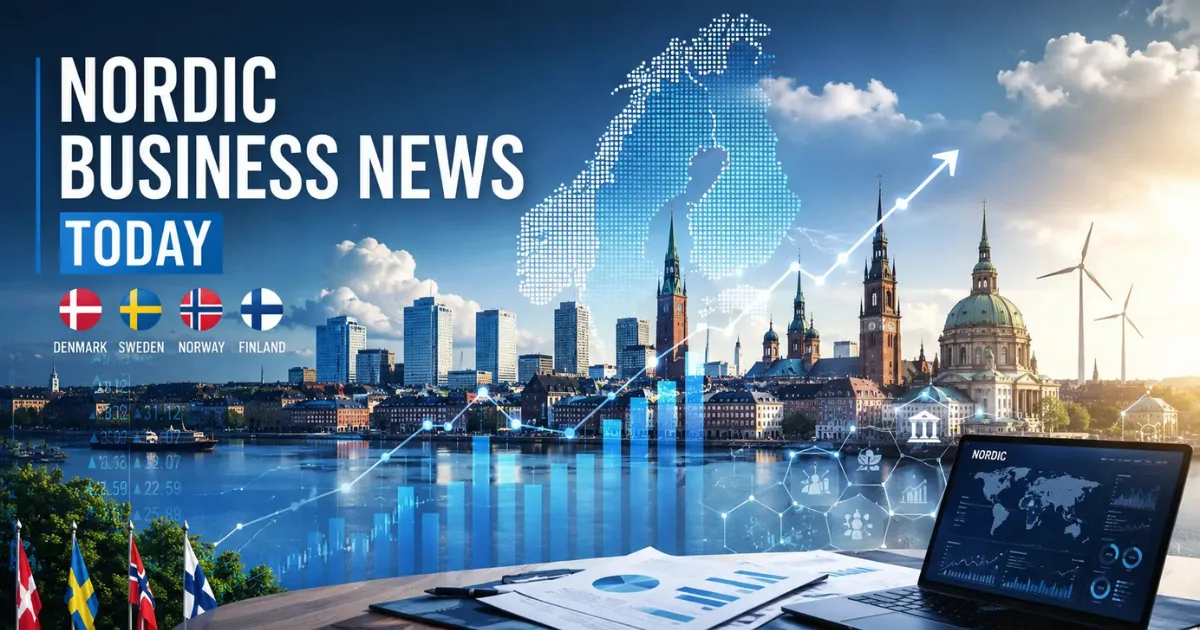
Nordic business news today is showing a region that is adapting, investing and competing despite a difficult global economy. Across Denmark, Finland, Iceland, Norway and Sweden, companies are watching demand, costs, technology and trade. The story is about how Nordic businesses are building resilience while searching for growth. For companies, the most important signals are practical: whether customers return, whether investment delivers results, and whether leaders can manage uncertainty without losing momentum. For investors, the same signals can reveal which businesses are prepared for the next phase. That makes daily business data especially useful when read alongside broader economic trends and policy changes today.
What are the biggest Nordic business stories today?
One clear theme is improving confidence in selected sectors. Fitness operator SATS reported second-quarter results on August 14, with stronger margins and pricing power helping lift investor interest. The company operates across Norway, Sweden, Denmark and Finland, showing how regional businesses benefit when customers keep spending.
Finland’s Anora Group also reported second-quarter results today. Revenue remained under pressure, but profitability improved, and investors responded positively. The lesson is simple: in a difficult market, stronger margins and cash generation can matter as much as sales.
How are Nordic economies performing?
The broader outlook remains mixed. A 2026 Nordic Business Outlook points to projected GDP growth of about 0.9% in Finland, 2.6% in Sweden, 2.1% in Norway and 2.1% in Denmark. Inflation and unemployment also differ sharply between countries.
Businesses therefore face different local conditions. Swedish companies may see stronger growth opportunities, while Finnish firms continue to deal with a tougher employment and demand environment. Norway has the advantage of a comparatively strong labor market, while Denmark continues to benefit from established export industries and high-value companies.
Nordregio’s State of the Nordic Region 2026 report examines business demographics and economic change across the Nordic countries (source: Nordregio). It shows Nordic firms have absorbed major shocks, including the pandemic, inflation and war-related economic effects.
Why are investors watching Nordic companies?
Investors are watching because Nordic markets combine mature companies with strong positions in technology, energy, healthcare, manufacturing and clean industry. The region also has deep cross-border links. Business Sweden’s 2026 climate survey found that sales and revenue are the main reasons Swedish companies consider the Nordic market important, while long-term strategy is another major factor.
Company results offer a practical example. SATS is benefiting from pricing initiatives and operating leverage, while Anora is demonstrating improved profitability despite weaker sales. Investors should look beyond revenue to costs, cash flow, margins and strategy.
This is why Nordic business news today can matter beyond Scandinavia. Regional companies often operate globally, offering clues about demand, investment and business costs.
What role is technology playing in Nordic business?
Technology remains one of the region’s strongest long-term opportunities. Nordic countries have established strengths in digital services, advanced manufacturing, clean energy and research. A new Nordic AI-health initiative described in Nature Medicine is another example of regional cooperation, using large health datasets to support responsible artificial-intelligence research (source: Nature Medicine).
The commercial impact could extend beyond healthcare. Data systems, automation and AI can reduce repetitive work, improve forecasting and develop services. Businesses also face regulation, cybersecurity, data protection and upgrade costs.
The key question is where AI can create measurable value. Firms linking technology spending to customer or productivity gains may be better positioned.
Are trade and geopolitics affecting Nordic businesses?
Yes. Trade policy, European conditions, energy security and Arctic geopolitics increasingly matter. Denmark, Norway, Sweden and Finland are operating in a more security-focused environment, while cooperation with European and international partners is becoming strategically important.
Recent Nordic diplomacy has highlighted green technology and innovation. India and the Nordic countries have moved toward a stronger strategic partnership focused on combining Nordic sustainability expertise with India’s scale and market opportunities. This could create openings for companies working in renewable energy, clean technology, digital systems and industrial innovation.
Businesses cannot ignore global uncertainty. Tariffs, shipping costs, currency movements and geopolitical tensions can quickly change investment plans. Companies with diversified suppliers, strong balance sheets and flexible operations may benefit.
What should businesses and investors watch next?
Next signals will come from earnings, inflation, employment, rates and consumer spending. Businesses will watch whether construction continues stabilizing. The 2026 Nordic Business Outlook notes that construction has faced heavy pressure, but also points to adaptation, including more specialized firms and changing demand.
Key areas to watch include:
Consumer spending and pricing power.
Technology and AI investment.
Energy and clean-industry projects.
Construction and property recovery.
Export demand and trade policy.
Employment and wage pressures.
The bigger story is resilience. Nordic companies face pressure, but many are adjusting. The region remains worth watching for investors, entrepreneurs, workers and consumers.
For more regional coverage, [insert related article link here] can connect readers with another Europe business update and keep them exploring the site.
Why does Nordic business news today matter to ordinary people?
Business news affects jobs, prices, salaries, investment and services. Investment can create jobs. Higher costs can raise prices. Higher productivity can improve competitiveness and services.
The Nordic story is bigger than stocks. It is about how economies respond to pressure while protecting growth. Today’s developments suggest a region balancing caution, opportunity and innovation.
FAQs:
What is Nordic business news today?
Nordic business news today covers major company, market, economic and investment developments across Denmark, Finland, Iceland, Norway and Sweden.
What sectors are strongest in Nordic markets?
Technology, energy, healthcare, manufacturing, consumer services and clean industry remain important Nordic business sectors.
Which Nordic countries are seeing stronger growth?
Current 2026 forecasts show Sweden, Norway and Denmark ahead of Finland on projected GDP growth.
Why are Nordic companies attractive to investors?
They often combine strong international brands, innovation, disciplined management and exposure to global markets.
Where can readers follow Nordic business updates?
Readers can follow company results, economic data and regional developments through reliable financial and official sources.
Comments (0)
Be the first to comment.
Related stories
 Business
GLUBOND Opens Distribution Opportunities for Partners Across Pakistan
GLUBOND Opens Distribution Opportunities for Partners Across Pakistan
 Business
How to Become Famous on Social Media Without Chasing Every Trend
Want more followers and attention online? Learn how to become famous on social media through original content, consistency, smart trends, engagement, and audience-focused strategies.
 Business
How to Run Effective Facebook Ads and Get Better Results
Want better results from Facebook advertising? Learn how to run effective Facebook ads with smarter targeting, compelling creatives, testing, budgeting, and performance tracking.