
Airstrike Approved: What the Israel-Iran Tensions Mean
Israel approved plans for additional airstrike targets in Iran and Lebanon in March 2026, according to Defense Minister Yisrael Katz. Here is what the decision means and why it matters.
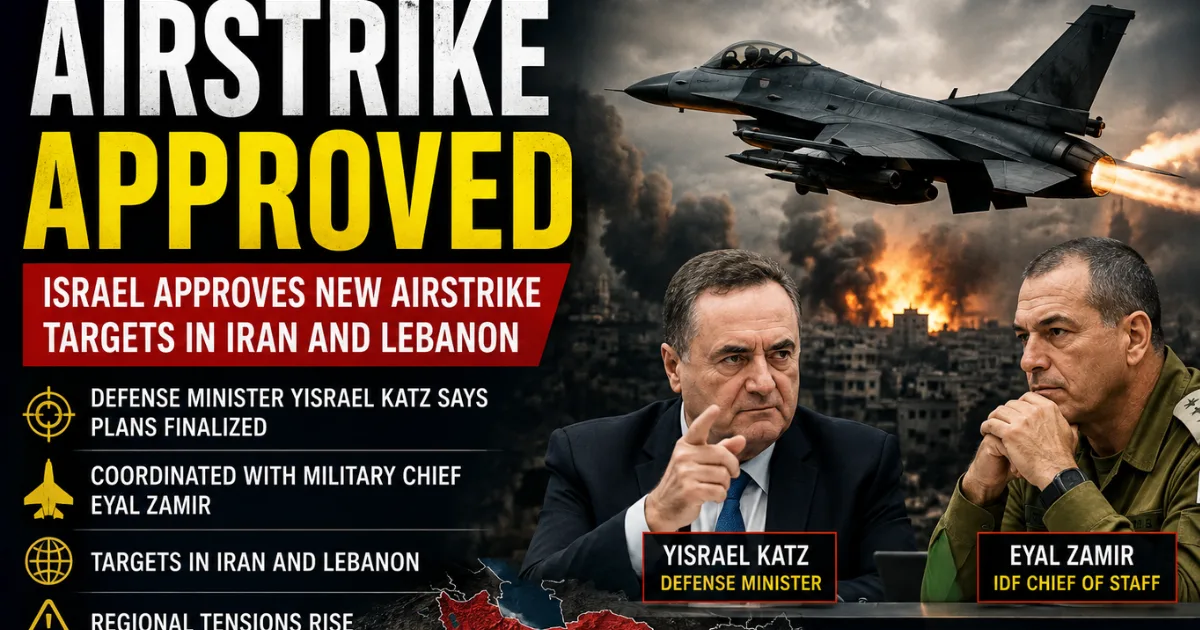
The phrase airstrike approved drew attention after Israel’s defense minister, Yisrael Katz, said on March 25, 2026, that plans had been approved for additional strikes against targets in Iran and Lebanon. Coming during intense regional fighting, the announcement raised questions about the targets, the decision and what could happen next.
What does “airstrike approved” mean in this case?
In this case, “airstrike approved” refers to plans for additional Israeli military strikes that Katz said had been finalized in coordination with military chief Eyal Zamir. Reporting at the time said the targets were in Iran and Lebanon.
Approval of a target plan does not necessarily mean every strike happens immediately. Military operations can change because of intelligence, weather, aircraft availability, diplomatic pressure, civilian-risk assessments, or developments on the ground. Readers should therefore distinguish between an approved plan and a completed attack.
Reuters Connect, carrying an Anadolu Agency image and description from March 25, reported that Katz said new targets had been finalized during a security assessment meeting. (source: Reuters Connect)
Why were new targets being approved?
The decision came amid continuing military operations involving Israel, Iran and armed groups in Lebanon. The reported target approval was therefore part of a wider regional confrontation rather than an isolated event.
Iran and Israel have repeatedly treated military capabilities, weapons infrastructure, command centers and other strategic assets as major security concerns. Lebanon adds another layer because Hezbollah, an Iran-backed armed group, has long been involved in conflict with Israel.
Details behind individual targets are often classified, while public statements may describe broad objectives without revealing intelligence sources.
For readers, the important point is simple: an official statement about target approval confirms a military decision, but it does not automatically confirm the exact location, timing, or outcome of a future strike.
What did Yisrael Katz say?
Katz said the targets had been finalized in coordination with Zamir during a security assessment. Contemporary reporting described the planned strikes as targeting additional sites in Iran and Lebanon.
That statement mattered because Katz was serving as Israel’s defense minister, making his comments directly relevant to Israel’s military policy and operations.
However, statements from officials involved in an active conflict should still be read carefully. They represent the position of the government or military making the statement. Independent reporting is needed to establish what happened on the ground, including damage, casualties and whether a planned strike actually occurred.
This distinction is especially important when social media posts or headlines turn an official announcement into a claim that an attack has already happened.
What could the decision mean for Iran and Lebanon?
The approval of additional targets could signal that Israel intended to maintain military pressure rather than pause operations. For Iran, new strikes could increase the risk of another round of retaliation. For Lebanon, expanded Israeli operations could put further pressure on communities already affected by fighting.
Escalation may affect diplomacy, border security, civilian movement, infrastructure, energy markets and international efforts to prevent a wider war.
A plan can be modified, delayed, narrowed or abandoned. An operation can also trigger responses that were not visible when approval was announced.
Are civilians at risk when airstrikes are approved?
Yes. Any military strike in or near populated areas can create risks for civilians, even when forces say they are targeting military objectives. Civilian protection is a central issue in international humanitarian law, which requires parties to armed conflicts to distinguish between military objectives and civilians and to take feasible precautions.
The International Committee of the Red Cross explains that international humanitarian law requires parties to take precautions to avoid or minimize civilian harm during attacks. (source: ICRC)
That is why reports about airstrikes should not focus only on whether a target was destroyed. Reports should examine civilian casualties, damage to homes and services, displacement, and evidence supporting claims about military targets.
For more background, readers can explore [insert related article link here] on how international law applies to modern air campaigns.
How can readers verify claims about an approved airstrike?
The safest approach is to compare several credible sources and check the date of every report. In fast-moving conflicts, old photographs, recycled videos and incomplete claims can spread quickly.
A useful checklist is:
Check whether an official government or military statement exists.
Look for reporting from established international news organizations.
Confirm when the event happened, not just when a post was shared.
Separate claims about plans from confirmed reports of completed strikes.
Treat casualty figures as provisional until independently verified.
Reuters, the Associated Press, major broadcasters, government statements and the ICRC can provide useful starting points.
Has the situation changed since the approval?
Yes. The March 25 announcement should be understood as a snapshot of a much larger and changing conflict. Later developments in 2026 included further fighting involving Israel, Iran and Lebanon, meaning readers should not assume that the March announcement describes the current battlefield situation.
June reporting described renewed Israel-Iran exchanges, while July coverage examined Hezbollah disarmament and Israel-Lebanon tensions. (source: Washington Post)
That context also prevents a common mistake: treating a months-old approval as evidence that a strike is happening today.
What should readers remember about “airstrike approved”?
The key takeaway is that the phrase describes authorization or airstrike approved of a military plan, not necessarily a completed attack. In the March 25, 2026 case, Yisrael Katz said Israel had approved plans for additional targets in Iran and Lebanon, with the targets finalized in coordination with military leadership.
The announcement pointed to continued military pressure, but individual operations, timing and consequences require separate verification.
Readers should focus on confirmed statements and dated updates. A headline alone does not prove an attack occurred.
As the regional conflict evolves, the most useful reporting will explain not only what was approved, but also what happened afterward, who was affected, and what the development means for diplomacy and civilian safety. That approach gives readers a clearer picture than a single viral headline and helps distinguish verified developments from rumors, recycled footage, and unsupported claims circulating online during fast-moving conflicts where information can change rapidly and statements may be updated.
FAQs:
What does airstrike approved mean?
It means military authorities have authorized or approved plans for an airstrike, not necessarily that the attack has occurred.
Who approved the new Israeli airstrike targets?
Israeli Defense Minister Yisrael Katz said plans for additional targets had been approved and finalized with military leadership.
Which countries were mentioned in the airstrike plans?
The reported plans involved additional targets in Iran and Lebanon.
Does an approved airstrike mean it will definitely happen?
No, military plans can be changed, delayed, narrowed, or canceled.
Are civilians at risk from airstrikes?
Yes, strikes near populated areas can pose serious risks to civilians and civilian infrastructure.
Comments (0)
Be the first to comment.
Related stories
 International News
How to Increase Facebook Followers: Simple Strategies That Work
Want more Facebook followers without relying on fake accounts? Discover practical strategies for better content, Reels, engagement, collaborations, and organic growth.
 International News
How to Create a Facebook Page: Easy Step-by-Step Guide
Want to build your presence on Facebook? This simple guide explains how to create a Facebook page, complete your profile, publish content, and grow your audience.
 International News
How to Recover a Forgotten Facebook Password: A Simple Guide
Forgot your Facebook password? This simple guide explains how to recover your account, receive a recovery code, reset your password, and protect your account afterward.