
Palestine Colours: The Meaning Behind Black, White, Green and Red
The Palestine colours—black, white, green and red—are closely connected with the Palestinian flag, Arab history and Palestinian cultural identity. Here is what each colour represents.
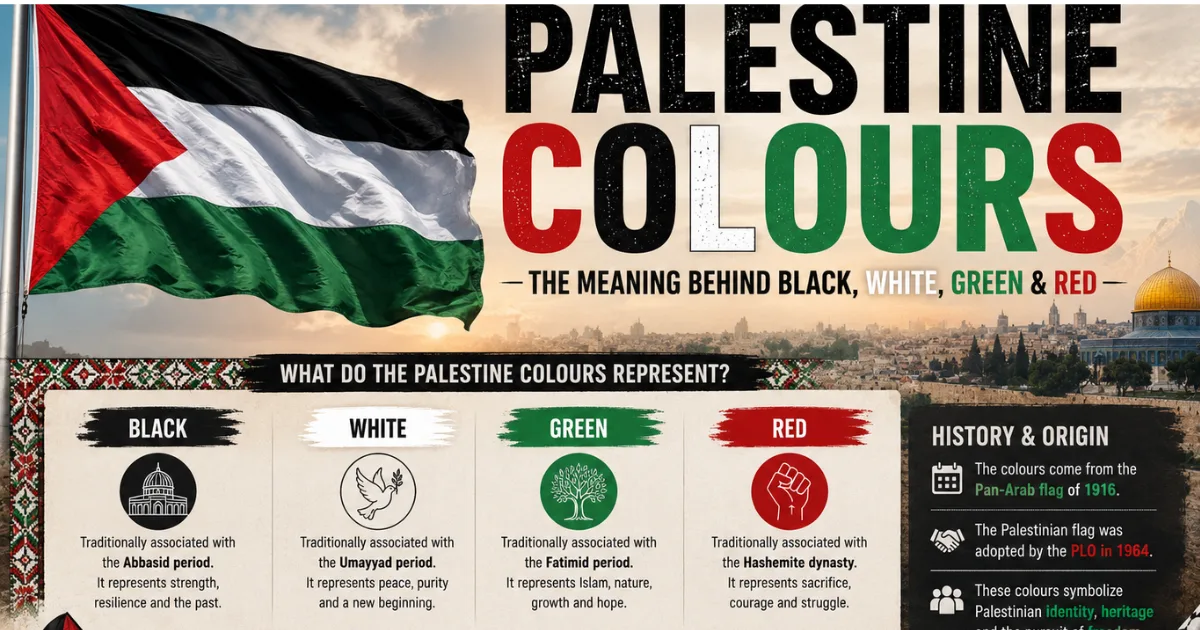
The phrase Palestine colours often brings four familiar shades to mind: black, white, green and red. Together, these colours form the Palestinian flag and have become widely recognised symbols of Palestinian identity, history and culture. But what do the colours mean, where did the design come from, and why are these shades so visible in art, clothing, sports and public spaces? The answers reach beyond a simple flag. They connect modern Palestinian identity with a much longer history of Arab symbolism.
What are the Palestine colours?
The Palestine colours are black, white, green and red. They appear on the Palestinian flag in four horizontal and triangular sections. The flag has three horizontal bands, with black at the top, white in the middle and green at the bottom. A red triangle extends from the flagpole toward the center.
The design is closely connected with the Pan-Arab colours. These colours also appear in the flags of several Arab countries, although each country uses them in a different arrangement. The Palestinian version has become one of the most recognisable visual symbols associated with Palestinian national identity.
What does each Palestine colour mean?
There are traditional interpretations for the four colours, although meanings can vary depending on the historical source.
Black is often associated with the Abbasid period and is sometimes linked with historical struggle or remembrance.
White is traditionally connected with the Umayyad period and can represent peace, purity or a new beginning.
Green is commonly associated with the Fatimid period and is also connected with Islam, nature and hope.
Red is often linked with the Hashemite dynasty and is commonly interpreted as representing sacrifice, courage or struggle.
These meanings are historical and symbolic interpretations, not a single official explanation.
Where did the Palestinian flag design come from?
The modern Palestinian flag is based on the Arab Revolt flag of 1916, which used the same four Pan-Arab colours. The colours were later incorporated into different Arab nationalist and Palestinian symbols.
The Palestine flag was formally adopted by the Palestine Liberation Organization in 1964. After the establishment of the Palestinian Authority, the same flag continued to be used as a major national symbol.
According to the Encyclopaedia Britannica, the Palestinian flag uses the Pan-Arab colours of black, white, green and red. (source: Encyclopaedia Britannica)
The design therefore resembles other regional flags while retaining a distinct Palestinian identity.
Why are Palestine colours important today?
For many Palestinians and supporters of Palestinian identity, these colours represent belonging, heritage and national aspirations. They appear on flags, scarves, posters, murals, jewelry and clothing.
The colours are also used during cultural events and demonstrations. A combination of four colours can communicate identity immediately, even without words.
Their meaning can be personal as well as political. People may use them to celebrate culture, remember family roots, show solidarity or highlight Palestinian history.
That flexibility has helped the colours remain relevant across generations.
Are Palestine colours the same as the Palestinian flag?
Yes, in everyday use, people often use “Palestine colours” to describe the four colours of the Palestinian flag. However, the phrase can have a broader meaning.
Artists may use the colours without reproducing the exact flag. A designer might create a pattern using black, white, green and red, while a clothing maker could combine the shades in a modern style.
The official flag has a specific arrangement, while other designs may simply use the same palette.
Why are these colours common in Palestinian art and fashion?
The combination is visually strong. Black and white create contrast, while green and red add energy. The four colours can work in traditional patterns as well as modern graphic design.
Palestinian embroidery, known as tatreez, is another important part of cultural expression. Traditional embroidery uses many colours and regional patterns. Contemporary artists may combine tatreez-inspired designs with the national palette.
This creates artwork that connects cultural heritage with contemporary identity.
[insert related article link here]
How can you use Palestine colours respectfully?
Context matters. If you are creating educational, cultural or design content, explain what the colours represent rather than using them only as decoration.
A few simple guidelines can help:
Use accurate historical information.
Avoid claiming that every colour has one universally accepted meaning.
Respect Palestinian cultural symbols.
Do not alter the flag in a way that creates a misleading political or historical claim.
When using embroidery or traditional patterns, credit the cultural tradition accurately.
For news publishers, neutral wording gives readers context without turning a cultural symbol into a slogan.
Why do people search for Palestine colours?
People often search the phrase after seeing the flag in news coverage, social media, sports, art or international events.
A concise answer is simple: Palestine colours are black, white, green and red, the four colours prominently used in the Palestinian flag. Their symbolism is connected with Arab history, Palestinian identity and national heritage.
The colours have survived because symbols can communicate quickly. A flag does not need a paragraph to be recognised; four familiar shades can carry memories, history and identity at a glance.
What is the main takeaway about Palestine colours?
Palestine colours are more than a popular colour combination. Black, white, green and red are tied to the Palestinian flag and to a wider history of Pan-Arab symbolism. Their meanings have developed through history, culture and modern national identity.
The colours can represent heritage, identity, solidarity and cultural memory, depending on who is using them and why.
The story of these colours also shows how visual symbols can remain powerful for generations. Whether they appear on a flag, a piece of artwork, a scarf or a digital graphic, the colours immediately connect viewers with a recognisable Palestinian symbol.
For more background, readers can explore reputable historical references such as Britannica and educational resources about Palestinian history and culture. Understanding the story behind a symbol makes it easier to discuss it accurately and respectfully.
FAQs:
What are the Palestine colours?
Palestine colours are black, white, green and red, the four colours used prominently in the Palestinian flag.
What does the green colour represent?
Green is traditionally associated with the Fatimid period and is also linked with Islam, nature and hope.
What does the red colour represent?
Red is traditionally linked with the Hashemite dynasty and is often associated with sacrifice, courage and struggle.
Why are Palestine colours important?
They represent Palestinian identity, heritage, cultural memory and national symbolism for many people.
Are Palestine colours the same as the Palestinian flag?
In common usage, yes, although the phrase can also describe designs that use the same four-colour palette.
Comments (0)
Be the first to comment.
Related stories
 International News
How to Increase Facebook Followers: Simple Strategies That Work
Want more Facebook followers without relying on fake accounts? Discover practical strategies for better content, Reels, engagement, collaborations, and organic growth.
 International News
How to Create a Facebook Page: Easy Step-by-Step Guide
Want to build your presence on Facebook? This simple guide explains how to create a Facebook page, complete your profile, publish content, and grow your audience.
 International News
How to Recover a Forgotten Facebook Password: A Simple Guide
Forgot your Facebook password? This simple guide explains how to recover your account, receive a recovery code, reset your password, and protect your account afterward.